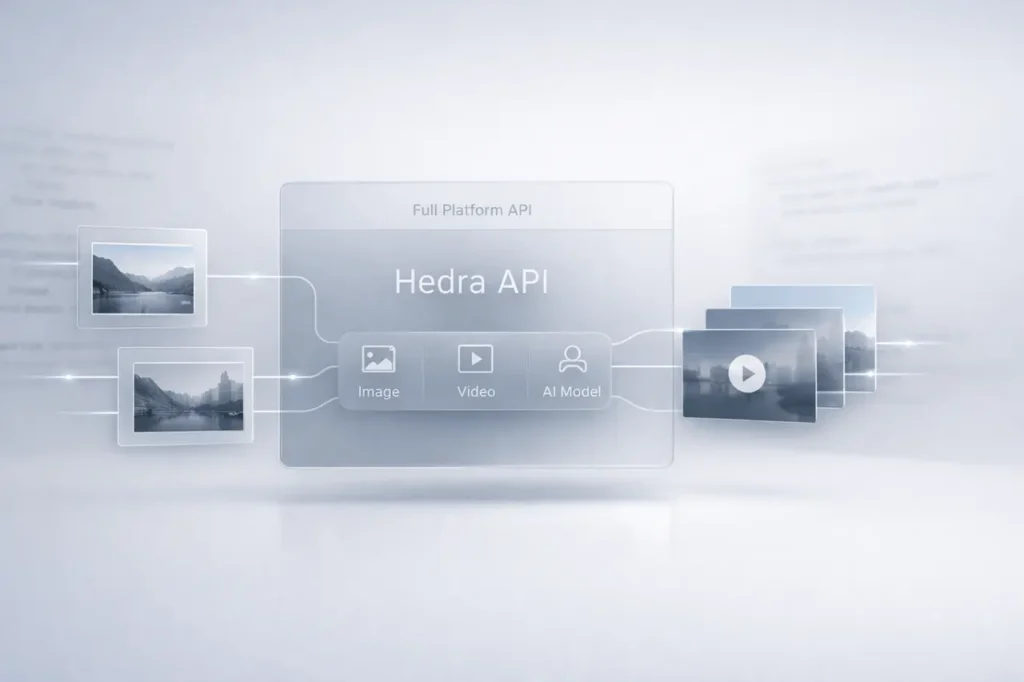
Hedra Full Platform API provides programmatic access to all Hedra models for video and image processing, enabling developers to create custom workflows, embed the power of generative AI into their applications, and implement automated creativity at scale. With the full API release, Hedra makes its multimodal generation stack accessible to both software and product developers.
This change places Hedra as an empowering developer-focused AI platform that offers complete control over creativity and integration for companies creating AI-based products.
What Is the Hedra Full Platform API?
Hedra Full Platform API provides a programming interface for developers that exposes Hedra’s full set of video and image generation models via programmatic endpoints.
Instead of using an internet interface, developers are now able to:
- Generate videos and images through API calls
- Automate creative pipelines
- Embed Hedra into SaaS products
- Build AI-powered media tools
- Output parameters for control at the scale
This change transforms Hedra from a stand-alone creative tool into a programmable AI infrastructure layer.
Why the Hedra API Launch Matters?
The accessibility of API access to the fullest extent signals an expansion of the strategic direction towards:
- AI-first product builders
- Media automation platforms
- Creative SaaS companies
- Integrations into workflows for enterprise
By enabling the creation of custom workflows and backend automation, Hedra aligns with broader trends in generative AI platforms that prioritise developer flexibility.
For businesses developing AI software, API access is critical. It permits:
- Scalability
- Workflow management
- Real-time generation
- Integration into existing systems
Without API access, innovative AI is a closed system. Through it, AI becomes infrastructure.
Core Capabilities of the Hedra Full Platform API
1. Complete Programmatic Access
Developers have access to all Hedra models for video and images via a structured API.
This permits:
- Automated generation pipelines
- Batch processing
- Server-side rendering
- Dynamic content generation
Programmatic access is vital for platforms that generate massive amounts of content, such as AI-powered marketing automation systems or media applications.
2. Custom Workflow Creation
The API allows you to create customised workflows, such as:
- Image-to-video pipelines
- Multi-step generation processes
- AI-driven editing flows
- Dynamic content personalisation
Developers can mix Hedra models with different AI platforms, databases, or automation tools to create fully customised engine designs.
3. Product Integration
Hedra can be integrated directly into:
- SaaS platforms
- Creative design tools
- AI assistants
- Media editing software
- Enterprise dashboards
It means that Hedra is ideal for businesses that wish to incorporate the capabilities of generative video or images directly into their customer-facing applications.
4. Full Creative Control for Developers
API-level access generally allows the ability to configure the API in a granular manner, for example:
- Prompt customization
- Parameter tuning
- Output resolution control
- Iterative refinement
- Chaining of workflows
It is vital for teams that need accuracy, reproducibility and the sameness of their products.
How does the Hedra Platform API work?
The details of implementation depend on SDK documentation, and support API-based generative AI platforms typically adhere to this pattern:
- Authentication via API keys
- Generation parameters to be submitted
- Asynchronous processing
- Retrieval of output generated
Developers can incorporate the steps in backend applications, web services, and automation workflows.
This structure permits Hedra to act as a generator of ideas in larger systems.
Feature Comparison: Web Interface vs API Access
| Capability | Web Interface | Full Platform API |
|---|---|---|
| Manual content creation | Yes | Yes (via code) |
| Automation support | Limited | Full |
| Batch processing | Limited | Supported |
| Product integration | No | Yes |
| Custom workflow chaining | Minimal | Extensive |
| Scalable infrastructure | Limited | High |
The API extends Hedra from a simple tool for users into an infrastructure layer for artificial intelligence-driven media products.
Use Cases by Industry
| Industry | API Application | Business Benefit |
|---|---|---|
| Marketing | Automated ad creative generation | Faster campaign iteration |
| E-commerce | Dynamic product visuals | Personalized customer experience |
| Media & Entertainment | AI-generated video content | Reduced production costs |
| SaaS Platforms | Embedded creative AI features | Increased product value |
| Education | AI-driven visual content creation | Scalable learning materials |
These use cases demonstrate how API access can enable broader adoption across the enterprise.
Benefits of the Hedra Full Platform API
Scalability
Businesses can produce thousands of images and videos without any manual intervention.
Customization
Developers have complete control over prompts, parameters, and the workflow structure.
Integration Flexibility
The API permits the seamless connection with
- Backend systems
- Databases
- Cloud services
- Automation platforms
Product Differentiation
Companies can develop exclusive creative experiences based on Hisdra’s model.
Practical Considerations for Developers
When using the dynamic AI API, such as Hedra’s teams, consider:
- Infrastructure requirements
- Latency expectations
- Cost-per-generation
- Moderation of output and compliance
- Model management by version
Proper implementation ensures reliable performance in production environments.
Limitations and Challenges
API access grants the power; however, it also brings obligations:
- Managing API quotas
- Handling asynchronous workflows
- Monitoring content output
- ensuring compliance with platform policies
The successful implementation requires careful design and oversight of operations.
Hedra in the Broader AI Ecosystem
The growing popularity of generative API platforms is a reflection of an overall shift in industry trends towards:
- Multimodal AI systems
- Developer-first AI tooling
- Infrastructure-grade generative models
- AI integration into enterprise software
By offering full API access, Hedra positions itself among platforms that value the ability to extend and program beyond the user interface.
Future Implications of the Hedra Platform API
The complete API access could signal a shift towards:
- AI-native application development
- Automated media pipelines
- Scalable generative infrastructure
- embedded AI experiences
As more businesses develop AI-driven products, access to powerful APIs that generate data becomes essential rather than an option.
Hedra’s Full Platform API represents a move towards using generative media as a programmable infrastructure.
My Final Thoughts
Hedra Full Platform API marks an important shift in how developers use and deploy the generative models for video and image. Through enabling full access to programming, custom workflow creation, and seamless integration with other products, Hedra transforms its platform into a scalable AI infrastructure.
For companies developing AI-based products, automated media pipelines, or embedded creative tools, API-level access is crucial. Hedra’s shift to full developer control aligns with the trend toward making generative AI adaptable, programmable, and ready for the enterprise.
As generative systems continue to shape our digital world, platforms offering scalable APIs will play a major role in the next generation of AI-powered apps.
FAQs
1. What is the Hedra Full Platform API?
The Hedra Full Platform API provides programmatically accessible access to all Hedra models for video and image generation, allowing developers to incorporate generative capabilities into workflows and applications.
2. Can developers incorporate Hedra in their products?
Yes. The API was designed to enable direct integration into products, enabling SaaS platforms and enterprise tools to integrate video and image generation features.
3. Does the API allow custom workflows?
Yes. Developers can create multi-step workflows and automate generation pipelines and chain processes with API calls.
4. What industries could benefit most from Hedra API?
Industries such as media, marketing, e-commerce, education, and SaaS can utilise the API to automate content creation and expand their product offerings.
5. Is the Hedra API suitable for large-scale applications?
Yes. API-based access allows automation and scalability. This makes it ideal for high-volume production use cases.
Also Read –