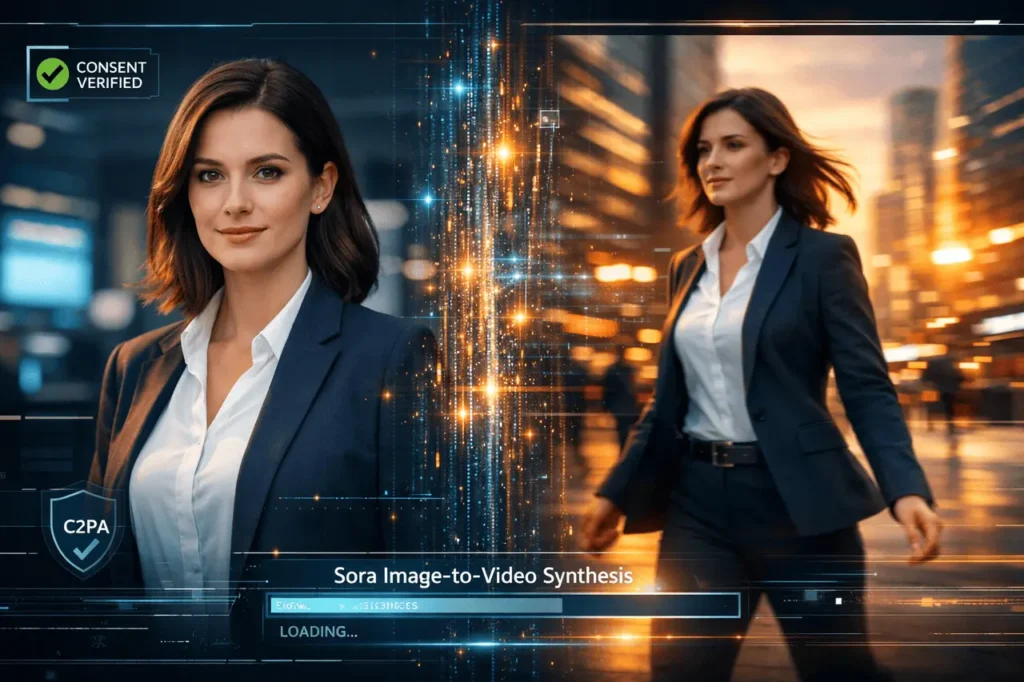
The world of generative video was transformed in February of 2025 when OpenAI enhanced its capabilities for its Sora model. The update enabled converting static photos of people into high-quality, dynamic videos. By bridging the gap between cinematography and photography, Sora’s ability to convert images into video enables unmatched consistency in character movements and interactions with the environment.
This innovation is notable for its emphasis on security and ethical use. In contrast to previous video creation methods that relied solely on text-based prompts, the Sora image-to-video feature can provide an anchor visual, ensuring the resulting video retains the subject’s characteristics and appearance.
How Sora Image-to-Video Works?
Sora uses a diffusion transformer to determine how pixels will move over time. If an image is given as a reference point, Sora treats it as the initial frame in a sequence. The model then calculates motion in accordance with the user’s instructions while adhering to the visual information in the original file.
The Function in Visual Anchoring
In the traditional generation of text-to-video, keeping “character constancy”-the capability of people to see in the same way from various angles is an important technical challenge. With an image used as a reference, Sora can keep particular features, such as clothing textures and facial features, as well as lighting conditions.
Motion Synthesis
After the photo is uploaded, users can indicate the action they want to take. Sora analyses the spatial relations within the image to determine how the user should interact with their surroundings, ensuring that movements appear fluid and anatomically realistic.
Confirmation of Consent, Mandatory and Ethics Moderation
Rigorous new security protocols accompanied the introduction of video-to-image features for human subjects. Since the 4th of February 2025 update, OpenAI has introduced an obligatory attestation process. Users must affirm that they have obtained the consent of anyone featured in the uploaded content and that they have the legal right to use it.
Moderation Layers
Sora utilises a multi-tiered moderation system to prevent the production of non-consensual or harmful content. This includes:
- For Input Screening: Automatic systems scan uploaded images for illegal content or public figures who are well-known.
- Prompt Filtering: Instructions in the text are scrutinised to ensure they do not contain “deepfake” manipulations of style or sexually explicit content.
- Visual Output Monitoring: The finalised video undergoes another review to ensure it complies with safety guidelines before being released to users.
Technical Requirements and Specifications
To use these functions, they must meet certain eligibility requirements, currently geared toward safety testers and creative professionals. The table below provides the key elements of the Sora video-to-image update.
| Feature | Specification |
| Release Date | February 4, 2025 |
| Source Material | User-uploaded static images (JPEG, PNG) |
| Primary Requirement | Attestation of consent and media rights |
| Core Functionality | Animating people and consistent characters |
| Safety Measures | Stricter moderation and C2PA metadata tagging |
Application-Based Applications to Video Generation
The ability to create animated people using images opens new possibilities for many sectors. With an image of high-quality creators can avoid the randomness commonly caused by pure generative Artificial Intelligence (AI).
Storyboarding and Pre-Visualisation
Filmmakers can use headshots, concept art, or concept drawings of actors and make “living narrative boards.” This lets directors visualisevisualise how characters might move in a scene before the costly physical production begins.
Personalized Marketing
Brands can use an image of a product featuring an individual model and produce multiple video variations to be shared across websites. This can significantly reduce the cost of traditional shoots while ensuring brand consistency.
Digital Heritage and Archiving
Historical and museum curators may use the technology to help bring historic photos to life, offering an enhanced way for the general public to connect with the past, as long as copyright and ethical requirements regarding deceased people are considered.
Advantages over the limitations of Sora Image-to-Video
While Sora is a major leap in AI video, it is essential to understand what technology can do and what it cannot achieve at the moment.
| Category | Advantages | Limitations |
| Visual Fidelity | High resolution and realistic textures | Occasional physics “glitches” in complex movement |
| Consistency | Keeps character features stable across frames | May struggle with intricate hand or finger motions |
| Control | Precise control over the initial visual state | Restricted by strict moderation filters |
| Efficiency | Faster than traditional 3D animation | High computational cost for long sequences |
Practical Tips for Users
When using Sora to produce videos of individuals’ lives, picture quality is the most crucial aspect. High-resolution images with bright lighting yield the best results.
- Keep it Simple: Clean backgrounds let the AI concentrate on the user’s movements without affecting the surroundings.
- Clean Subjects Photographs in which the subject is directly facing the camera or is in a clear face tend to be more predictable than photos with faces that are obscured.
- Descriptive Prompts: If images are provided, the prompt text should clearly specify the level and direction of the movement to avoidavoid “uncanny” or robotic movements.
Importance of Provenance and Metadata
To counter misinformation, Sora’s videos are accompanied by C2PA (Coalition for Content Provenance and Authenticity) metadata.
An electronic “paper trail” confirms it was produced or altered by AI. As generative tools become more advanced, transparency standards are crucial to maintaining trust in digital media.
My Final Thoughts
The development of Sora into a tool capable of creating animated human beings from static images is an important milestone in the field of generative AI. With the emphasis on moderated consent, it aims to reconcile creative freedom and ethical accountability.
As models continue to improve their understanding of human physicshuman physics and interactions with the natural world, the gap between a single photo and a filmic sequence will only get smaller. For filmmakers interested in the future of film, it isn’t just about what can be captured or how existing images can be transformed using artificial intelligence.
FAQs
1. Can I upload a photograph of someone else to Sora?
No. You need explicit permission from the person in the photograph and the right to use the photo. Sora’s moderation system is designed to prevent unauthorised use of images, specifically those of celebrities.
2. What did we learn from the February 2025 Sora update?
OpenAI permitted users with valid credentials to upload pictures of their loved ones to create videos. The update also required users to confirm that they had given their consent. It also added stricter guidelines to ensure the security of the created content.
3. Is Sora accessible to the general public?
As of the beginning of 2025, Sora remains in a restricted release phase. It is typically restricted to a select group of creative professionals, researchers and “red team members” who assist in identifying any potential vulnerabilities in the system.
4. What is the difference between image-to-video and text-to-video?
Text-to-video can create a scene from a written description, leading to erratic outcomes. Image-to-video uses a photo as a base, ensuring the character and setting remain the same throughout the video.
5. Does Sora include watermarks in videos?
Yes, videos created by Sora typically contain visual identifiers and C2PA metadata that indicate the content was created by artificial intelligence.
Also Read –