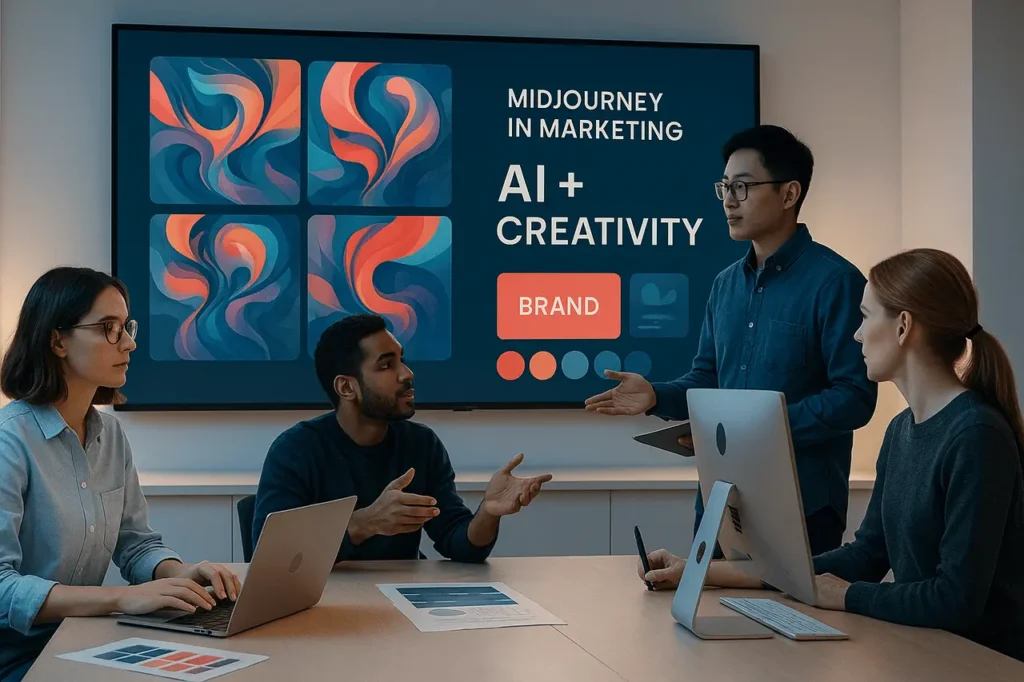
Artificial Intelligence (AI) has changed the world of marketing and is changing the way brands think about the concept, design, and implementation of campaigns. One of the most effective tools driving this change can be found in Midjourney, which is an AI imaging platform that utilizes text prompts to produce stunning, high-quality images.
Marketing agencies will appreciate Midjourney because it isn’t just a tool for design -it’s also an accelerator of creativity. It allows designers and marketers to conceptualize ideas in a matter of minutes, develop unique brand assets, and keep a consistent creativity across campaigns.
This article will look at the midjourney of marketing agencies throughout their day-to-day activities, including conceptual visualisation and branding through to the creation of content and ads, and how it’s changing workflows for creative work.
What Is Midjourney?
Midjourney is an AI powered image generator tool that converts text-based messages into pictures. It’s similar to tools such as DALL-E as well as Stable Diffusion; however, it is distinguished due to its aesthetic depth, artistic appeal, and adjustable outputs in style.
The majority of agencies use Midjourney via Discord, the platform, which lets users enter commands like:
Imagine a futuristic urban skyline in the evening, Cinematic lighting, and realism.
In a matter of seconds, Midjourney generates several high-quality versions of the image you requested.
The outcomes often match or even exceed the work humans can design, which makes Midjourney an ideal platform for marketing professionals who require speed, innovation, and a variety of visuals.
How Marketing Agencies Use Midjourney
Marketing agencies use Midjourney in many ways to increase productivity, creativity, and campaign effectiveness. Here are some of the prominent examples of how to use Midjourney:
1. Concept Development and Brainstorming
Before beginning a campaign, agencies typically need to think of diverse creative possibilities. Usually, this requires designers to design plans or sketches, which can be a lengthy process.
With Midjourney, teams can quickly think of a myriad of creative ideas.
For instance:
- Digital agencies can create diverse ad concepts for the launch of a product.
- A branding team may create mood boards of visuals that reflect the brand’s people (luxurious, minimalistic, striking, etc. ).
- Marketing professionals on social media can think of ideas for content with instant visuals.
Teams can deliver more polished pitches and help clients be quicker to approve and evaluate ideas.
2. Brand Identity and Design Exploration
Midjourney allows agencies to investigate color schemes, logos, and typography ideas as well as concepts of visual identity.
Although it’s not meant to replace professionals, professional branding designers can serve as a basis for creativity. For example:
- Agents can design logo concepts or even mascots.
- They can also test designs for rebranding projects.
- It assists designers in discovering new directions for their aesthetics before the design process itself.
Through offering a wide array of visual outcomes, Midjourney aids in creating a distinctive, consistent, and appealing brand image.
3. Social Media Content Creation
Social media thrives on visually appealing content. Midjourney lets marketing agencies create images that are scroll-stopping and align with the themes of their brands.
Examples of use cases include:
- Visuals of the product: Generate AI-enhanced product mockups that are used in everyday settings.
- Campaign graphics: Make eye-catching graphics for Instagram, X (Twitter), and LinkedIn.
- Content for storytelling: Design narrative-driven visuals for short or carousel-like videos or carousels.
With Midjourney, companies can create large quantities of content fast and test which designs are most effective, and ensure uniform branding across various platforms.
4. Advertising and Promotional Materials
Ad campaigns typically require multiple visual versions to test. Midjourney’s AI enables fast A/B testing through the generation of various ads that are based on the same concept.
For example:
- Create banner ads for different target audiences.
- Create unique backgrounds or backdrops to shoot product images.
- Conceptualize imagery for stories.
Through automation of a large portion of creativity, agencies can cut down on time and expense while still ensuring top design quality.
5. Content Marketing and Blog Illustrations
Content and blog teams often have a difficult time finding original, copyright-safe images that can be used for niche topics. Midjourney helps solve this issue by creating customized photos that are in perfect alignment with the subject of the article.
Examples:
- Infographics and feature images to accompany blog posts.
- Illustrations for whitepapers and eBooks.
- Images for newsletters sent to email and case studies.
Utilizing Midjourney, agencies can improve the quality of their content. This improves CTR (CTR), read time, and the overall level of engagement.
6. Creative Pitches and Presentations
When agencies present their campaigns to their clients, visual storytelling plays an important part. Midjourney lets teams visualize campaign concepts, such as mood boards and storyboards for ads, quickly.
With realistic mockups as well as creative directions, agents can help make their presentations more convincing and visually appealing, which can increase customer satisfaction rates.
7. Product Visualization and Prototyping
For eCommerce clients or those who sell products, Midjourney is able to create real-life models or product images prior to shooting or manufacturing.
For instance:
- Fashion brands are able to preview clothes in various color variants.
- Tech companies can design the gadgets before launching.
- A real estate agency can design conceptual renderings of both exteriors and interiors.
This allows clients to see the potential outcomes earlier, which improves the efficiency of decision-making and collaboration.
Benefits of Midjourney for Marketing Agencies
Marketing agencies prefer Midjourney because of its efficacy and capacity. Traditional image creation usually requires hiring illustrators, photographers, or even designers, which can be expensive and time-consuming. Midjourney helps by creating images in only a few minutes, which allows companies to test their ideas quickly.
One benefit is the savings on costs. Agents can create custom graphics without outsourcing, which reduces production costs while maintaining quality. AI can also increase creativity. AI is able to mix elements with fashions in ways we can’t imagine, creating innovative concepts for campaigns.
There is also speed as an advantage. In the realm of changing fashions in just a few minutes, Midjourney allows for rapid adjustments to the requirements of customers or shifts in market trends. For instance, the process of generating seasonal graphics or A/B testing visuals is now a breeze. In addition, it assists remote teams by offering the use of an internet-based platform, which can be accessed from anywhere in the world, encouraging collaboration among agencies across the world.
If it is used ethically, Midjourney assists agencies in making sure that they do not use too many photos from stock sources, creating distinct assets that contribute to the image of the brand. But, they should be aware of the issues of copyright and originality that will be addressed in the coming.
Challenges and Limitations
Although Midjourney is a potent tool, it’s not without difficulties:
- Insufficient Brand Control: Designs created by AI can sometimes be a bit off from the strict guidelines for brands.
- Copyright Uncertain: Agencies must ensure that their images do not infringe on already existing IP rights.
- The Learning Curve: Crafting with speed requires skills to produce the desired outcomes.
- Human Oversight is Needed: AI can help, but cannot completely substitute human decision-making and creativity.
Agencies typically combine midjourneys with designers to ensure professional quality in alignment with the brand.
Best Practices for Agencies Using Midjourney
- Utilize Descriptive Questions: Make sure you are specific about the tone, style, and composition.
- Maintain consistency of brand: Train teams to make use of Midjourney outputs that match the brand’s color palette and themes.
- Combine AI with Human Editing: Utilize tools such as Photoshop and Canva to enhance AI-generated graphics.
- Keep it Legal: Avoid using prompts that resemble copyrighted content.
- Workflows for Documents: Establish internal standards to use AI-generated content safely.
The Future of AI in Marketing Design
As AI tools such as Midjourney continue to develop, marketing agencies will more and more incorporate them into complete creative workflows.
Future developments may include:
- Incorporation into design programs (Figma, Adobe) to allow seamless editing.
- Dashboards for team collaboration with agencies.
- Advanced options for customization to align with the brand style automatically.
AI-assisted creative thinking will soon be the norm, allowing agencies to create more efficiently, with greater intelligence and more personalised advertising that is visually appealing.
Final Thoughts
Midjourney has been a crucial agency partner in marketing, mixing AI technology with human imagination. It helps teams think quickly, develop more innovative designs, and produce visually captivating campaigns with unparalleled effectiveness.
As AI tools for design continue to improve, businesses that embrace these tools early will have a competitive edge by redefining the possibilities of visual storytelling and advancing marketing.
FAQs
1. Does Midjourney offer a free service to marketing agencies?
It is not an online tool that is subscription-based. Agencies can select from a variety of paid plans based on their usage and requirements for image generation.
2. Are agencies able to use Midjourney imagery commercially?
Indeed, users who pay do have exclusive commercial rights to images they create, but agencies should check the most current licensing terms of Midjourney.
3. Does Midjourney replace human designers?
Not entirely. Although Midjourney improves speed and creativity, human designers remain crucial to ensure consistency in branding as well as storytelling and final polishing.
4. What kinds of content are available for agencies to develop using Midjourney?
Agents use it to create advertisements for social media images, blogs, website visuals, brand assets, and conceptual art.
5. How can they achieve the most effective results from Midjourney?
With detailed prompts, testing different styles, and refining the result through human editing.