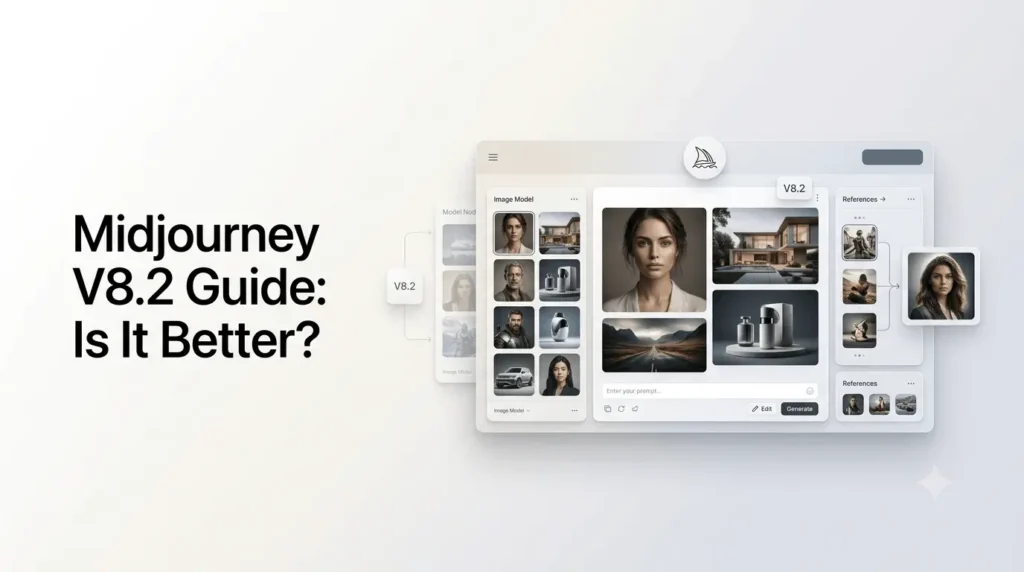
Midjourney V8.2 is now the default image model, and it is a meaningful refinement rather than a completely new generation. Released on July 24, 2026, V8.2 focuses on aesthetics, image quality, and personalization while introducing a new Edit Model that changes how users work with reference images and image editing.
For most creators, V8.2 is the version to use today. However, “better” depends on what you do with Midjourney. If you prioritize polished aesthetics, personalization, high-resolution output, and a more integrated editing workflow, V8.2 is a strong upgrade. If your workflow depends heavily on V7-specific features such as Omni Reference, you need to understand the differences before switching.
This Midjourney V8.2 Guide explains what’s new, how V8.2 compares with V7 and V8.1, how to use its major features, what changed with reference images, how much Midjourney costs, and whether V8.2 is worth using.
Quick Summary
- Midjourney V8.2 is the current default model, focusing on better aesthetics, image quality, and personalization.
- The new Edit Model supports editing, inpainting, outpainting, and up to four reference images.
- V8.2 offers HD image generation and improved creative control through tools like Raw Mode and Style References.
- V7 remains useful for workflows relying on Omni Reference.
- Overall, V8.2 is the better choice for most new projects, especially for creators seeking improved quality and modern editing workflows.
What Is Midjourney V8.2?
Midjourney V8.2 is the current default version of Midjourney’s image-generation system. It launched as the default model on July 24, 2026, following V8.1, with a focus on improved aesthetics, image quality, and personalization.
According to Midjourney, V8.2 is designed to produce images that are:
- More creative
- Bolder and more sophisticated
- Edgier and fresher
- Less likely to produce unexpectedly low-quality results
- Better aligned with a user’s personalization preferences
The biggest practical change is not simply the appearance of generated images. V8.2 also introduces the Edit Model, which combines image editing, reference-image generation, inpainting, and outpainting into a newer workflow.
What Changed in Midjourney V8.2?
V8.2 is best understood as an evolution of the V8 generation rather than a completely separate platform.
The main changes are:
1. Improved aesthetics
Midjourney says V8.2 produces images that are more creative, bold, sophisticated, edgy, and fresh. It also aims to reduce random low-quality generations.
This matters because Midjourney’s strength has traditionally been visual aesthetics rather than simply following a prompt literally. V8.2 continues that direction.
2. Better Personalization
Personalization receives particular attention in V8.2.
Midjourney says personalization should better understand a user’s aesthetic preferences, especially when the user has accumulated many ratings. V8.2 also provides a larger and improved pool of images for creating personalization profiles.
Your existing Global V7 Personalization Profile can also work with V8.2. New V8 profiles can be created, although V8 profiles are not compatible with V7.
3. The new Edit Model
This is arguably the most important workflow change.
The V8.2 Edit Model can:
- Edit an existing image using written instructions
- Generate images using up to four reference images
- Replace the previous Omni Reference and Character Reference workflow
- Perform inpainting
- Expand an image using outpainting
- Work with Image Prompts, Style References, Moodboards, Personalization, and HD mode
Midjourney began wider testing of the V8.2 Edit Model on August 27, 2026, and continued improving its image quality shortly afterward.
Midjourney V8.2 vs V8.1 vs V7
The differences between versions are more important than simply asking which one produces the “best” images.
| Feature | V7 | V8.1 | V8.2 |
|---|---|---|---|
| Status | Older selectable model | Older selectable model | Current default |
| Release | 2025 | April 14, 2026 | July 24, 2026 |
| Main focus | Strong generation + Omni Reference | Speed, coherence, HD | Aesthetics, quality, personalization |
| Personalization | Yes | Yes | Improved |
| HD output | No | Yes | Yes |
| Omni Reference | Yes | Legacy V7 system | Replaced by Edit Model |
| Edit Model | No | Supported | Core new workflow |
| Up to 4 reference images | No | No | Yes with Edit Model |
| Inpainting/outpainting | Older workflows | Supported | Edit Model |
| Style References | Yes | Yes | Yes |
| Image Prompts | Yes | Yes | Yes |
| Raw Mode | Yes | Yes | Yes |
V8.1 introduced HD images and was described by Midjourney as its fastest model at the time, with standard jobs rendering approximately four to five times faster than earlier versions. V8.2 then became the default with its emphasis on aesthetics, image quality, and personalization.
One important distinction: don’t assume every advantage associated with V8.1 is a new V8.2 feature. Some capabilities were introduced earlier in the V8 generation and remain available in V8.2.
Is Midjourney V8.2 Better Than V7?
For most new image-generation projects, yes. But V8.2 is not a universal replacement for every V7 workflow.
V8.2 is the better choice if you want:
- The current default Midjourney experience
- More developed aesthetics
- Improved personalization
- HD generation
- Modern image editing
- Multiple reference images
- Inpainting and outpainting through the Edit Model
V7 can still be useful when you specifically need its older workflow, particularly Omni Reference.
Midjourney’s current documentation explicitly recommends using the Edit Model for V8.X rather than Omni Reference. Omni Reference remains compatible with V7.
So the answer is less “V8.2 destroys V7” and more “V8.2 is the better general-purpose choice, while V7 remains relevant for specific legacy workflows.”
What Happened to Midjourney Omni Reference?
This is one of the biggest changes users moving from V7 need to understand.
Omni Reference allowed users to place a character, object, vehicle, or creature from a reference image into a new generation. V7 supported the --oref parameter and allowed one image to be used as the Omni Reference.
With V8.X, Midjourney has moved toward the Edit Model.
Instead of relying on a dedicated Omni Reference control, the Edit Model allows up to four reference images and combines reference-based generation with editing capabilities.
That means a workflow such as:
Reference character → new environment → preserve visual identity
can now be approached through the V8.2 Edit Model rather than the old V7 Omni Reference system.
For users who have older V7 projects built around --oref, however, this change requires some adjustment.
How Does the Midjourney V8.2 Edit Model Work?
The Edit Model is designed to make editing more instruction-driven.
Instead of generating an entirely new image every time, you can start with an existing image and tell Midjourney what you want changed.
For example:
Original: A fashion portrait of a woman wearing a black jacket.
Edit instruction: Change the jacket to a cream-colored leather jacket and place the subject in a modern Parisian café.
The model can then use the existing image as the starting point rather than requiring you to recreate the entire scene through a new text prompt.
The Edit Model supports three major workflows:
- Instruction-based editing
- Reference-image generation
- Inpainting and outpainting
This makes V8.2 considerably more interesting for production workflows than a simple image-generation upgrade.
How to Use Midjourney V8.2?
The easiest way to use V8.2 is through the Midjourney website.
Step 1: Open the Create page
Go to Midjourney and open the image creation interface.
V8.2 is the current default version, so you generally don’t need to manually select it.
Step 2: Write your prompt
Start with the subject and describe the scene, composition, lighting, environment, and desired visual characteristics.
For example:
Editorial portrait of a futuristic architect inside a minimalist concrete studio, soft window lighting, muted neutral palette, cinematic photography, sophisticated fashion styling
Step 3: Choose your aspect ratio
Use --ar when working in Discord, or the corresponding controls on the website.
For example:
--ar 16:9Midjourney starts with a square format by default, but aspect ratio can be changed for portrait, landscape, and other compositions.
Step 4: Adjust Stylize
The --stylize or --s parameter controls how much artistic interpretation Midjourney applies.
For example:
--s 100Midjourney currently supports stylize values from 0 to 1000, with 100 as the default. Lower values generally make the result more literal, while higher values give Midjourney more freedom to interpret the prompt.
Step 5: Try Raw Mode when you need more control
Raw Mode reduces some of Midjourney’s automatic stylistic influence.
For photographic or more controlled results, try:
--rawMidjourney says Raw can be particularly useful when you want a more realistic or tightly controlled result.
Step 6: Use the Edit Model when references matter
If you already have an image and want to change it, or you want to combine multiple references, move into the Edit Model workflow.
You can use up to four reference images with the V8.2 Edit Model.
Midjourney V8.2 Prompt Examples
Here are a few practical V8.2 prompt structures.
Photorealistic portrait
Professional editorial portrait of a young architect standing inside a minimalist concrete studio, soft natural window light, realistic skin texture, subtle shadows, muted gray and beige palette, premium fashion photography –ar 4:5 –raw
Product advertising
Premium wireless headphones floating above a dark stone pedestal, controlled studio lighting, subtle reflections, sophisticated luxury advertising photography, clean background, realistic product materials –ar 16:9
Cinematic scene
A lone astronaut walking through an abandoned coastal city at sunrise, distant fog, dramatic architectural scale, cinematic composition, restrained colors, atmospheric photography –ar 21:9
Using text in an image
Midjourney supports text generation by placing the desired words inside double quotation marks.
For example:
Minimalist coffee shop poster with the words “MONDAY COFFEE” in large elegant typography, Scandinavian design, off-white paper texture
Midjourney recommends double quotation marks for text and notes that shorter text generally works better. Raw mode or lower stylization can also help when exact text is important.
Does V8.2 Support HD Images?
Yes.
The V8 generation introduced HD images, with V8.1 supporting higher-resolution 2K output without requiring a separate upscale step. Midjourney’s current documentation groups V8.1 and V8.2 together for HD support.
For V8.2, standard-definition images begin at 1024 × 1024 pixels at a 1:1 aspect ratio. Creative and Subtle upscalers can increase SD images to 2048 × 2048 pixels. HD images are generated at 2048 × 2048 pixels automatically and currently cannot be upscaled further.
This is useful for:
- Website hero images
- Editorial artwork
- Social media graphics
- Concept art
- Advertising concepts
- Print-oriented creative work
However, output dimensions vary with aspect ratio, so 2048 × 2048 should not be treated as the resolution for every V8.2 image.
What Are the Best V8.2 Features for Creators?
Personalization
Personalization is particularly valuable if you generate images frequently.
Instead of repeatedly explaining your preferred visual style, you can train Midjourney’s personalization system through image selections and ratings. The system then uses those preferences when generating images.
Style References
Style References remain useful when you want to transfer the visual characteristics of an image without copying its actual subject.
They can influence elements such as:
- Color
- Texture
- Lighting
- Medium
- Overall visual mood
Unlike a character or object reference, a Style Reference is primarily about the look and feel.
Moodboards
Moodboards let you curate a group of images to establish a broader aesthetic direction.
They can be particularly useful for:
- Brand development
- Campaign concepts
- Editorial projects
- Character worlds
- Consistent visual identities
Midjourney describes Moodboards as a personalization system that can communicate a broader aesthetic than a single Style Reference.
Image Prompts
Image Prompts allow you to include an image alongside text so that Midjourney can use the image as inspiration for composition, content, or visual direction.
The important distinction is that an Image Prompt is not necessarily intended to reproduce the source image exactly.
What Are the Limitations of V8.2?
V8.2 is more capable, but it is not perfect.
1. It is not a perfect prompt-following system
Midjourney still prioritizes visual interpretation. A highly detailed prompt can produce an attractive image while changing or omitting some requested details.
If exact control matters, use lower stylization, Raw Mode, and iterative editing rather than relying on one enormous prompt.
2. Text can still require iteration
Midjourney has improved text generation, but exact typography is still a workflow rather than a guarantee.
Shorter text generally works better, and you may need several generations or an editing pass for professional designs.
3. V7 workflows do not always transfer directly
The move from Omni Reference to the Edit Model is a significant workflow change.
Creators with established V7 reference workflows should expect to experiment with the new system rather than simply copying old commands into V8.2.
4. The Edit Model is still evolving
Midjourney has continued publishing updates to the V8.2 Edit Model, including an image-quality update on August 29, 2026.
That means some behavior and interface details can change as Midjourney continues testing and refining the system.
How Much Does Midjourney V8.2 Cost?
V8.2 is included with Midjourney’s subscription plans rather than being sold as a separate model.
As of September 2026, Midjourney lists four plans:
| Plan | Monthly Price | Annual Price | Fast GPU Time |
|---|---|---|---|
| Basic | $10/month | $96/year | 3.3 hours/month |
| Standard | $30/month | $288/year | 15 hours/month |
| Pro | $60/month | $576/year | 30 hours/month |
| Mega | $120/month | $1,152/year | 60 hours/month |
Annual billing provides a 20% discount compared with monthly pricing. Standard, Pro, and Mega plans include unlimited image generations in Relax Mode. Stealth Mode is available on Pro and Mega.
For most individual creators, the Standard plan is likely the more practical starting point if they generate images regularly because it includes Relax Mode for unlimited image generation.
Who Should Use Midjourney V8.2?
V8.2 is particularly well suited to:
AI artists
Creators who care about aesthetics, atmosphere, composition, and artistic interpretation will likely appreciate the direction of V8.2.
Graphic designers
The combination of image generation, references, personalization, and editing makes V8.2 useful for developing visual concepts quickly.
Marketers
Marketing teams can use V8.2 for:
- Campaign concepts
- Social media imagery
- Product advertising
- Editorial graphics
- Creative testing
- Moodboards
Content creators
Bloggers, YouTubers, publishers, and social creators can use V8.2 to develop original visual assets rather than relying entirely on stock imagery.
Brand designers
Personalization, Style References, and Moodboards can help establish repeatable visual directions across creative projects.
Who Should Continue Using V7?
V7 remains relevant when a specific workflow depends on features that were designed around it.
The clearest example is Omni Reference. Midjourney’s documentation states that Omni Reference is compatible with V7, while V8.X users are directed toward the Edit Model instead.
Therefore, if an existing production pipeline depends on --oref, it may make sense to retain V7 for those particular projects while learning the V8.2 Edit Model for new work.
Midjourney V8.2 vs Other AI Image Generators
Whether V8.2 is the “best” AI image generator depends heavily on the task.
Midjourney remains particularly compelling for users who prioritize:
- Artistic aesthetics
- Creative interpretation
- Visual exploration
- Style development
- Image references
- Personalized aesthetics
- Iterative visual workflows
However, users whose primary requirement is extremely literal prompt execution, specialized graphic design workflows, or a particular ecosystem may prefer another image-generation platform.
The more useful question is therefore not “Is Midjourney V8.2 the best?” but:
Does V8.2 fit the way you create images?
For creators who already prefer Midjourney’s aesthetic approach, V8.2 is a strong continuation of that workflow.
Best V8.2 Workflow for Beginners
If you’re new to Midjourney, avoid starting with complicated parameter-heavy prompts.
A simple workflow is:
- Describe the subject
- Describe the environment
- Add composition
- Specify lighting
- Add the desired visual style
- Choose an aspect ratio
- Adjust Stylize if necessary
- Use Raw when you need more control
- Iterate using variations
- Move to the Edit Model when the image is close but not quite right
For example:
Luxury electric sports car parked outside a minimalist concrete house at sunset, wide architectural composition, soft cinematic lighting, realistic materials, premium automotive photography –ar 16:9
Generate several versions first. Then refine the strongest result instead of attempting to describe every possible detail in the initial prompt.
Tips for Getting Better Results in V8.2
Keep the core prompt focused
Longer prompts are not automatically better. Give Midjourney a clear hierarchy of information.
Use Stylize intentionally
If the image is too artistic, reduce the stylize value.
If it feels too literal, increase it.
Use Raw for controlled photography
Raw can help when you want your prompt to have more influence over the final visual treatment.
Use Style References for visual consistency
When the important element is the look rather than the actual subject, Style References are usually more appropriate than object references.
Use the Edit Model for corrections
If the composition is already good, don’t throw it away just because one detail is wrong.
Use editing to change the problematic area or describe the desired modification.
Build personalization gradually
The more useful preference information Midjourney has, the more valuable Personalization becomes. Midjourney specifically recommends spending time selecting images for personalization profiles.
Is Midjourney V8.2 Worth It?
Yes, for most Midjourney users.
V8.2 is currently the default model and improves the overall experience through stronger aesthetics, better personalization, HD capabilities inherited from the V8 generation, and a much more ambitious editing workflow.
The biggest reason to use it isn’t simply that the images look different from V7. The more important change is that Midjourney is bringing generation, references, editing, inpainting, and outpainting closer together through the Edit Model.
There is one important caveat: V8.2 changes some established V7 workflows. In particular, creators accustomed to Omni Reference should learn the new Edit Model rather than expecting the old --oref workflow to behave the same way.
For new projects, V8.2 is the sensible starting point. For existing V7 projects, keep the older model available when its specific capabilities are still important.
Final Verdict
Midjourney V8.2 is a worthwhile upgrade for most creators, but it is better viewed as a refinement of the V8 generation than a completely different Midjourney experience.
Its strongest improvements are the emphasis on aesthetics and personalization and the introduction of the Edit Model. The latter is particularly important because it replaces the older V7-centric approach to reference images with a workflow that can combine editing, multiple references, inpainting, and outpainting.
If you’re starting a new Midjourney project, V8.2 should be your default starting point. If you’re migrating an established V7 workflow, especially one based on Omni Reference, test the Edit Model before completely abandoning your older setup.
In short: V8.2 is better for the modern Midjourney workflow, but V7 can still be the right choice for specific legacy workflows.
Frequently Asked Questions
1. Is Midjourney V8.2 better than V7?
For most users, yes. V8.2 is the current default and focuses on improved aesthetics, image quality, personalization, and a new Edit Model. However, V7 still has value for workflows that depend on Omni Reference.
2. When was Midjourney V8.2 released?
Midjourney V8.2 became the default version on July 24, 2026.
3. Does V8.2 have Omni Reference?
Not as the native V8.X workflow. Midjourney recommends using the V8.2 Edit Model instead. The Edit Model supports up to four reference images and replaces the older Omni Reference and Character Reference workflow for V8.X.
4. Can Midjourney V8.2 generate 2K images?
Yes. V8.2 supports HD generation at 2048 × 2048 pixels for a square image. HD dimensions vary according to aspect ratio, and HD images currently cannot be upscaled further.
5. Is Midjourney V8.2 free?
Midjourney’s current plans are subscription-based. The Basic plan starts at $10 per month, while Standard, Pro, and Mega cost $30, $60, and $120 per month respectively.
6. What is the best Midjourney V8.2 setting for realistic images?
There is no single best setting for every photograph. A useful starting point is Raw Mode with moderate or lower stylization, followed by iterative prompting and editing. Raw reduces some of Midjourney’s automatic stylistic influence and can provide more control.
Also Read –
How to use Midjourney on Discord? A Complete Guide to AI Image Generation
Beyond Single Prompts: How to Use Midjourney Omni Reference Like a Pro?
Mastering Midjourney Style Reference: How to Control Any Aesthetic Like a Pro?
Midjourney Character Consistency: A Complete Guide
How to Use Reference Photos in MidJourney: A Step-by-Step Guide (2026)